
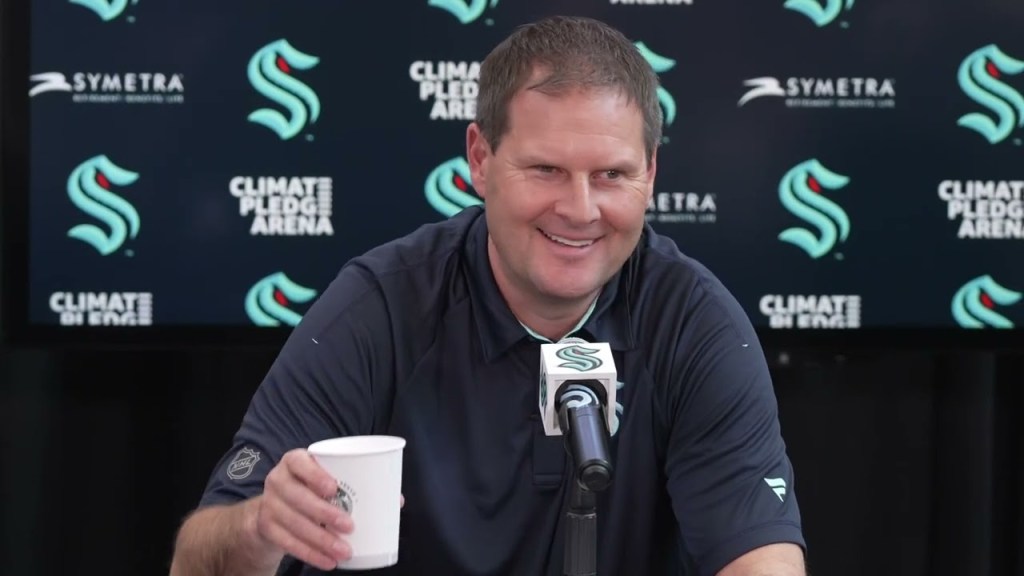
Though the playoffs are only a few days old, the Seattle Kraken have already started to make some moves following their disappointing 2024-25 regular season. The team has moved on from head coach Dan Bylsma, while also promoting Ron Francis. While Francis will remain in the management group, assistant GM Jason Botterill was promoted to the GM position.
While a new head coach is yet to be named, some information can be gleaned from the hiring of Botterill as the new GM. Let’s take a look at where we might expect the Kraken to go from here.
Buffalo
Botterill has been an assistant GM with several teams, but his most notable experience is as GM of the Buffalo Sabres. The GM from 2017 until 2020, the Sabres’ struggles existed before Botterill and have outlasted him as well. While things did not go according to plan in Buffalo, some tendencies might still be observed from his time there. Botterill made many trades, signings, and draft picks that may or may not be indicative of his plans for the Kraken.
His draft record is relevant given the volume and quality of the picks that the Kraken already have. As the GM for three drafts, Botterill had the luxury of picking high all three seasons. He was able to add some elite talent that defined the Sabres, even seasons after his departure. There are two notable players selected in each of his three drafts, Casey Mittlestadt and Uho-Pekka Luukkonen in 2017, Rasmus Dahlin and Mattias Samuelsson in 2018, and Dylan Cozens and Erik Portillo in 2019.
Some might find it worthwhile to criticize his drafting, pointing out that other players may have been better picks. However, there were no huge busts, which is a good sign. The most interesting observation might be the emphasis on goaltending, as Botterill selected Luukkonen in the second round and Portillo in the third, significant assets devoted to the position in three years.
Trades
Many trades are specific to a team’s given circumstance. Trying to buy or sell at the deadline, or trying to offload salary, many trades are difficult to understand without the specific context of the teams surrounding it. Still, Botterill has shown some interesting tendencies.
For starters, Botterill and the Sabres traded up in the draft twice during his tenure. While these trades involved middle-rounders, it did make sense for the Sabres to be more aggressive. A perennial rebuilder, the Sabres were already loaded with picks and prospects. Essentially Botterill already had the volume to use as insurance, and rewarded his scouts by trading up for players they really liked. If anything, it shows that Botterill can make an unbiased assessment of his team’s assets and react accordingly.
Botterill was also aggressive in trading prospects that he did not draft. Some of his biggest trades involved recent Sabres draft picks, resulting in some of the biggest trades during his tenure. Jeff Skinner was acquired for Cliff Pu and a bevy of draft picks, while Henri Jokiharju was acquired straight up for Alex Nylander. While Skinner’s eventual extension may have been costly, these trades were clear wins for Botterill. Both trades assessed major needs, and getting then-captain Jack Eichel a legitimate scoring winger was important for the overall morale of the club.
The other biggest trades by Botterill may have been tougher to call. He took a big swing at current Kraken Brandon Montour, trading for the promising young defenceman. As it did for many Sabres players of the era, things did not go well for Montour. A stint with the Florida Panthers revealed that Montour was good all along, and it was merely a strange curse that seems to afflict the Sabres that was to blame.
Another player who saw the joy of the game slip away over this time was Ryan O’Reilly. Though the Sabres had reason to believe a strong trio of Eichel, O’Reilly, and Sam Reinhart would make for a great forward group, somehow the team never found traction. The poor results weighed on everyone involved, and quite frankly, Botterill had no choice but to trade O’Reilly.
Of course O’Reilly would go on to win the Stanley Cup and the Conn Smythe Trophy with the St. Louis Blues, but the Sabres would fetch a key return. Tage Thompson was acquired in the deal, alongside a first and second round pick. Not all the pieces of the deal ended up working out as well as the Sabres might have hoped, but to land Thompson is a big win.
The rest of Botterill’s trade history shows us that he is comfortable dealing with smaller assets. He routinely found deals to upgrade his team using only mid-round draft picks and was able to sell lower-priced assets for some lower picks in return. Some might have questioned his deadline buying in his final year with the Sabres, but we might conclude that his job was on the line. Botterill did not go quietly, spending to upgrade his group, but did so to a responsible degree.
Signings
Again, the Sabres’ general ineptitude might tint our view. Botterill signed many players to short, inexpensive deals as Sabres GM. There were some successes, as Botterill was able to sign useful players at cap hits under $1 million. The Sabres would have needed to overpay to lure big-time free agents, and to an extent, Botterill deserves credit for not splurging.
This tactic may have hurt him at times, as many see not committing to Sam Reinhart long-term as a missed opportunity, as the team opted for a bridge deal instead. Carter Hutton may have been a miss as well, though with a cap hit under $3 million and a three-year term the deal was not crippling. Outside of this, Botterill seems to have done well in extending some of his players. Linus Ullmark and Robin Lehner were resigned, joining Luukkonen, Portillo, Hutton, and Chad Johnson as goalie investments. Botterill clearly made more good decisions than not, something that Kraken fans will surely be hoping for as well.
The most notable re-signings did not turn out too well for the Sabres, but should count for something on Botterill’s resume. Getting both Eichel and Skinner to sign big deals was seen as progress for the franchise, a sign that good players were willing to buy into Botterill’s vision. Yes, these deals aged poorly for the Sabres, but at the time, it was a huge moral victory to bring some stability to the top of the roster.
Hires
One of the biggest decisions for a GM is hiring a coach. For Botterill, the Sabres, and the two coaches he hired, things did not exactly go well. Funnily enough, Botterill’s tenure started after Dan Bylsma was let go as head coach of the Sabres.
The first hire was Phil Housley. As a player, Housley was an offensive defenceman. He was coming off an assistant coach role with the Nashville Predators, who had an impressive blueline under Housley. It seemed a sound choice, and Botterill certainly valued players who might thrive in such a system as well, evidenced by the additions of Dahlin, Montour, and Jokiharju. After two losing seasons, Housley was let go, the team collapsing down the stretch, as his message clearly was not getting through to his players.
The second hire was Ralph Krueger. While Krueger was previously an NHL head coach, his background was a bit more off the beaten path. Regarded as a teacher and a player’s coach, the thinking was clearly that Krueger could help the morale of the downtrodden Sabres. Once more the Sabres failed to reach the playoffs, spelling the end of Botterill’s tenure.
Since then the Sabres have undergone significant changes, trading Eichel, and gutting much of their scouting department. Still the team has yet to make the playoffs. Within their long playoff drought, Botterill’s seasons do not stand out as either the worst or the best.
Kraken
Since his time with the Sabres, Botterill has grown and learned. His first job after being let go was as assistant GM for the Kraken, and to an extent some of his fingerprints are within the organization already. For example, the Kraken have one of the more mobile bluelines in the league, with Montour joining Vince Dunn and Ryker Evans as legitimate puck moving options.
The area that should be in focus is goaltending. Though Joey Daccord played well, he alone does not constitute a solid situation. While hamstrung with Philip Grubauer’s contract, the Kraken do have some interesting prospects who are still some ways out from being everyday NHLers. Finding someone to push Daccord outright might be unreasonable, but bridging the gap ahead of the youngsters will raise the team’s floor during the regular season. Having a solid tandem is a great tool for success.
To reach the next level, this young Kraken team will have to grow and mature, something that comes with time and experience. The focus should be on finding a coach who can instill a strong defensive standard. This will help the goalies, and the Kraken do have the personnel strength to do so. With Matthew Beniers, Shane Wright, and Chandler Stephenson down the middle, the Kraken can become stout.
A hardened, short-term veteran might be a bit heavy-handed. John Tortorella, Gerrard Gallant, and Peter Laviolette all have histories of early success with teams, often wearing out their welcome not long after. Somehow, the priorities must be balanced, as the Kraken search for a potential long-term solution to grow into a solid defensive team. Perhaps the blueline might need another high-level defender to complement Adam Larsson, but the Kraken need more from the lineup as a whole.
Francis
While no longer the GM, Francis is still with the organization. Some might evaluate his track record as questionable, pointing to things that did not work, like his expensive misses in net. Still, Francis brought a lot of good qualities to the table, often building strong bluelines and showing great patience.
Essentially, one might synthesize this as Francis lacking some individual evaluations. The process has its merits, though, and Francis has been able to build up his organization as a whole more than he has achieved consistent on ice success. These traits seem to point to a greater aptitude as a team President, allowing someone else to handle the precise decisions. Francis will still bring wisdom and stability to the organization, but it was time to shuffle the deck in search for more.
Mission statement
Poised to add another impressive prospect, the Kraken will have one of the better pools around the league. The organization has its fair share of talented offensive prospects, led by the speedy playmaker Berkly Catton. One might imagine it would be hard to pass up on Porter Martone if the team has the chance, as his size and playmaking would be a great fit to diversify the Beniers, Wright, and Catton core.
At the same time, a high end defence prospect might be the ideal position, and the Kraken could have a shot at Adam Mrtka, Jackson Smith, or Logan Hensler. All three might not have what it takes to be true number one options, but they could significantly improve the quality of the blueline long-term.
With other talented forwards like Jagger Firkus and Eduard Sale already en route, Botterill will have an influx of reinforcements built into the roster. The team is not without some interesting defence prospects as well, such as Ty Nelson and Tyson Jugnauth.
In other words, it is time for the Kraken to start showing some on-ice improvements. With the high picks of this season’s draft haul, the Kraken also have two first-round picks in both 2026 and 2027, courtesy of the Tampa Bay Lightning. The future is in good shape, but it is time for the team to start striving for more. With so many young core pieces already in the lineup, the time is now for the team to start building an identity and some success behind it.
 Rinksiders
Leave a comment