
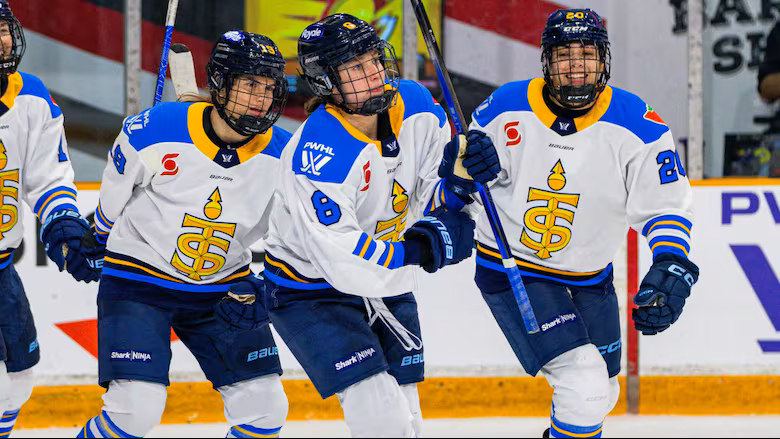
That didn’t take long at all. With two Canadian national team goaltenders, two Defender of the Year Award finalists alongside a strong supporting cast on the blueline, and seemingly every single big fish in free agency – PWHL Vancouver have solidified themselves as Walter Cup favourites before even playing their first game. If there is any criticism of the roster Cara Gardner Morey has constructed, it’s the risk/reward associated with a large portion of the team.
Rinksiders is proud to announce that all of our PWHL and Women’s Hockey content is moving to its own dedicated outlet: PDub Hockey!

Please follow along at pdubhockey.com and find all of our latest Women’s Hockey coverage there!
A lot of things have to go right for Vancouver to play up to their high expectations, and nowhere is that more apparent than their offence. Four players in the top ten of shooting percentage league-wide. Six who endured goal droughts that lasted double-digit games. Only one who doesn’t belong to either category, and one who somehow finds themselves in both. It’s a forward group that, in 2025, was either on fire or snakebitten with seemingly no middle ground in sight.
With so many outliers gathered in a single sample, it’s nigh impossible to predict how Vancouver’s offence will perform as a unit. Individually, though, it’s a much more manageable task. I’ll be taking a look at the past season(s) of each forward acquired through the expansion draft or free agency to try to predict if their breakout is sustainable or not, if they’re primed for a bounce-back campaign, or if there are signs of a continued decline.
(Shoutout, as always, to Kyle Cushman’s Master Spreadsheet for the statistics.)
Hannah Miller (Previous Team: TOR)
While Miller had a respectable year in the PWHL’s inaugural season, it’s safe to say very few expected her to be firmly in MVP conversations at the midway point of this one. Her season would feature a very defined peak, as after a February outburst of seven points in two games Miller finished the season with just two points, neither of them goals, in her last ten regular season contests. That, along with a 16.9% shooting percentage and over half her points coming on the power play introduce reasonable doubt as to whether or not she can replicate this level of production in Vancouver.
Funnily enough, Miller’s shooting percentage was actually down from 2024’s 17.9%, and she’s consistently shot 14% in Toronto’s two playoff series. She isn’t a volume shooter by any means, having the fewest shots on goal of all top-ten scorers in the PWHL (and barely over half of league leader Laura Stacey’s total), but Miller picks her spots well and that should buoy her special teams production. Even if the even-strength offence dips, though, that’s not where most of her merit lies.
If there existed an award for the league’s best defensive forward, Miller would win this season’s by a landslide. With her on the ice at five-on-five, Toronto, the worst even-strength team in the PWHL in 2025, allowed less than one goal per sixty minutes. She’s one of just six forwards who can make this claim, and one of only three who averaged over thirteen minutes of ice time. Comparing Miller’s numbers to the rest of her team only emphasizes just how good she was in her own end, with the only Sceptre even in the same area code being Laura Kluge in half a season of limited minutes.
Tangent aside, with some questions about Miller’s offensive output remaining unanswered by her other metrics, I have to temper my expectations of her production in 2025-26, especially without Daryl Watts on her line. That said, Miller easily becomes Vancouver’s most dependable forward and a clear choice for their 1C, even if her value may not be reflected in the flashier statistics.
Prediction: Unsustainable
Tereza Vanišová (Previous Team: OTT)
After a two-goal, ten-point season in 2024 split between Montréal and Ottawa, Vanišová exploded for a share of second in PWHL goal-scoring with 15, handily leading the Charge in the category. She did so with an efficiency unmatched by anyone, sitting tops in the league in individual scoring chances for (iSCF) with 81, and lapping the field in iSCF/60. There’s a little more to it than that, though.
A cursory way of representing how dangerous a player’s chances were on average is to calculate the ratio between scoring chances and total shots on goal, the closer the two numbers are together being an indicator of a greater share of high-quality opportunities. Vanišová recorded 0.92 individual scoring chances for every shot on net, the highest rate of anyone with at least 20 iSCF, and second only to countrywoman and former teammate Kateřina Mrázová among those with at least 15. Hilary Knight, who tied her in goals and had the second-highest iSCF total in the league, was at just 0.7 per SOG. No wonder Vanišová shot 17%.
Prediction: Sustainable
Michela Cava (Previous Team: MIN)
Something seemingly clicked for Cava the night of March 5, 2024 after she put a career-high five shots on goal without scoring, leaving her with two points in sixteen games while dropping her shooting percentage to 3.6%. Since then, she’s been the model of consistency with a statline that does not appear easy to replicate.
Amidst her breakout in the Frost’s first championship run, Cava shot 16% with a point-per-game rate of 0.8. She followed it up with 17% and 0.63 marks in the 2025 regular season, and 17.6%/0.63 in their title defence. It all screams unsustainable, yet there’s a season and a half plus four playoff series’ worth of evidence to the contrary.
Somehow, everything looks fine under the hood too. Cava played a major part in the most efficient even-strength scoring line in the PWHL in 2025. Seventeen of her nineteen points were primary. Even her shooting percentage can be partially explained through inflation from two empty net goals. The majority of the credit for her line’s success in Minnesota could arguably be attributed to Kendall Coyne Schofield, but in Vancouver she’s a natural fit on the wing of another elite five-on-five player in Miller. I don’t see a reason why Cava can’t keep riding this wave.
Unofficial Nat’s Stat segment stemming from me initially thinking she had more empty-netters than she actually did: Cava, over the course of the season, had three goals and five points in the last six minutes of regulation with the opposing goaltender still in the net. Boston’s Susanna Tapani was the only other player with at least four points in those situations.
Prediction: Sustainable
Jenn Gardiner (Previous Team: MTL)
I’m not going to go too far into Gardiner’s statistical profile here as it’s actually fairly solid across the board, with no outliers in either direction. Every question surrounding her production going forward is predicated on her linemates. Obviously, playing with Poulin and Stacey doesn’t walk you right to a Rookie of the Year nomination, but it certainly helps (I’d keep an eye on Natálie Mlýnková this season).
There were four games in which Gardiner did not play with at least one of the two, and she recorded a goal and an assist. However, the goal was on the power play, and no other forward was present on the scoring play for her assist. Of her remaining nineteen points in the regular season and playoffs, just four were on plays that did not involve Poulin or Stacey.
Abby Boreen did chip in on three out of the aforementioned four scores, making for a natural fit starting out in Vancouver, but the expansion team simply doesn’t have a forward who compares to the help Gardiner got in Montréal. I’d expect a bit of a sophomore slump as a result, especially since she plays the same wing as Vancouver’s biggest offensive threat in Vanišová.
Prediction: Unsustainable
Sarah Nurse (Previous Team: TOR)
The first instance of a player coming off a down year. Of all the ways for a season to get derailed, a collision with your club teammate at the Rivalry Series might just be the worst of them, and Nurse’s three points in ten games upon returning are certainly no consolation. Even before the injury, though, there was cause for concern.
Nurse’s shooting percentage predictably dropped off from the season prior’s 16.4%, but her on-ice metrics suffered in a way unbefitting of that anticipated fall. Her five-on-five scoring rate narrowly missed avoiding the bottom twenty among qualified forwards, sandwiching her between the likes of Theresa Schafzahl and Lexie Adzija. Schafzahl, to her credit, was one of the aforementioned six players with a GA/60 below one, but Nurse’s GA/60 doesn’t manage to be her saving grace either. Her 2.30 mark puts her just behind the season-long slump of Kristin O’Neill.
Prediction: Decline
Brooke McQuigge (Previous Team: MIN)
Regression to the mean, thy name is Brooke McQuigge. She’s the only player in the PWHL to shoot at least 20% while taking more than a single shot on goal (special thanks to Jessica Kondas for necessitating this caveat every single time). Of her seven assists, seven of them were secondary. McQuigge’s above average shot and scoring opportunity generation rates certainly heighten the floor for her production in 2026, but at a level that puts her 12th in P/60? No chance.
Prediction: Unsustainable
Abby Boreen (Previous Team: MTL)
Boreen’s linemate comparison is actually significantly more favourable than Gardiner’s. Eleven of her fourteen points came without help from Poulin or Stacey, including the first eight amidst her hot start to the season. As well, being a right-handed shot playing the same wing as Stacey, Boreen never had the luxury of lining up with both members of the duo like Gardiner did.
She also got put through Kori Cheverie’s line blender more than most. Over her final nine games Boreen had eight different linemates, leaving it difficult to make heads or tails of her on-ice metrics as she understandably struggled through that stretch. However, with depth being a strength of Vancouver’s instead of a weakness as it was in Montréal, Boreen should fare better, whether she plays with Gardiner or not.
Prediction: Bounce-Back
Denisa Křížová (Previous Team: MIN)
How Křížová went without a point through the 2025 playoffs is a mystery to me, and is honestly a microcosm of her PWHL career thus far. She’s an absolute scoring chance generation machine, but looking only at goals and points, you wouldn’t know it. Křížová had the second-highest iSCF/60 on the best offence in the league this season, yet has just three non-empty-net goals to show for it. She had more cumulative iSCF than Cava in an hour less total ice time, yet has half as many tallies. Basically, Křížová’s the anti-Cava. She even scored her first two career goals in the game mentioned in Cava’s section, just for good measure.
This isn’t even a single-season anomaly. In 2024, Křížová was 18th in iSCF despite a lower average ice time than every single player ahead of her, and again only had three goals on the year. Something’s got to give eventually, right?
Prediction: Bounce-Back
Izzy Daniel (Previous Team: TOR)
Originally, I had something in Křížová’s section about how she confuses me more than maybe any other player in the league, but I felt compelled to remove it after I looked more into Daniel’s season. Her first six games featured both of her goals, half of her hits, penalty minutes, and shots, and none of her assists. She was listed on the first, third, and fourth lines at least five times each, but the second line only once. She played with every Sceptres forward except for two, and the only one she combined with on more than a single scoring play was Miller.
Daniel’s shot and scoring chance generation rates aren’t exactly encouraging for the prospect of improvement going into 2026, but she’s also not even two years removed from winning the Patty Kazmaier Award. She’s somehow the biggest wild card on a roster chock-full of them. First 6 Games Izzy Daniel and Last 24 Games Izzy Daniel are completely different players, and it’s unclear which one Vancouver’s going to get, but I think it’ll even out to similar production to this year. A bit of a cop-out answer, sure, but I genuinely don’t know what to make of this.
Prediction: ???
Gabby Rosenthal (Previous Team: NY)
Rosenthal scored in her PWHL debut, and then didn’t score again. She centered the second line a couple times early in the season, but other than that, she was stuck in an anemic Sirens bottom six. An unremarkable rookie season on the surface, no doubt, but I actually think this was a shrewd pickup by Gardner Morey for a couple reasons.
I’d like to go back to the scoring chances to shots ratio I brought up in Vanišová’s section. Their seasons couldn’t have been much more detached from each other, with Vanišová seemingly scoring at will and Rosenthal struggling to break through, but in this stat that Vanišová leads the league in, Rosenthal actually places fourth with 0.9 scoring chances for every shot. It’s a smaller sample size, but she’s doing all the right things and should eventually be rewarded for it.
Rosenthal’s selection in the expansion draft was widely interpreted as a means to save cap space in order to splurge in free agency, and while they did end up doing so, she’s quite the valuable player to the team in her own right. With a little more luck on her side, Rosenthal could very well turn what currently looks like a weakness at 3C into a strength for Vancouver.
Prediction: Breakout





 Rinksiders
Leave a reply to Will Cancel reply